How to understand your Black Friday and Cyber Monday shoppers in 2026
Published 8 min read
Renny Chan Founder at Convo
10+ years of user research
TL;DR
Black Friday falls on 27 November 2026 and Cyber Monday on 30 November. Your sales data will show what people bought. Interviews show why they bought, why they hesitated and why they left a cart behind. To learn that this year, talk to shoppers before the weekend, follow them through it with a short diary study, and talk to them again once their orders arrive. With Convo, an AI interviewer runs those voice, video and chat interviews with real participants in 40+ languages, and turns them into themes, quotes and highlight reels as they come in.
Key takeaways
- Study three moments: plans and budgets before the weekend, decisions as they happen, and how the purchases feel once they arrive.
- Ask about what people did, not what they think: the last thing they added to a cart, the deal they almost took, the order they plan to send back.
- A multi-day diary study with photos and video catches decisions while they are fresh, instead of a week later.
- Researchers stay in control: they write and approve the discussion guide, set branching rules and test the interview before launch. If your team is busy running the sale, Convo’s research team can design, run and synthesise the study end to end.
This guide is for e-commerce, retail and brand teams who want to understand their Black Friday and Cyber Monday shoppers, not only count them. It covers what to study and when, the questions to ask, and how to turn the answers into decisions for next year’s sale.
We make Convo, so read this with that in mind. The method works with any way of interviewing people. We think that, given the close timeframe to Black Friday, running your research on Convo is a great option to be able to talk to a large sample of buyers quickly.
What your Black Friday dashboard can’t tell you
Conventional analytics are good at showing you what, but they don’t help you understand the why. They can’t show why someone bought, waited, or bought the same thing somewhere else. Those reasons are what change your offers, messaging and checkout experience.
An interview with each shopper can find out:
- Why a deal felt worth it, or felt too good to be true.
- What stopped someone finishing an order: the delivery cost, a better price elsewhere, second thoughts, or a checkout that got in the way.
- Whether a purchase was a gift, something planned and bought early, or an impulse.
- Where people compared prices, and what made them trust one shop over another.
- What brought them back on Cyber Monday, or kept them away.
A survey can count these reasons once you know them. An interview finds them in the first place, because a follow-up question can keep asking why.
Three key moments to study
Talk to the same shoppers three times: before the weekend, during it and after their orders arrive. That shows how plans turn into purchases, and how the purchases feel a week later.
- Before the weekend: plans, budgets and wish lists, where they’ll look first, and what a real deal means to them. Ask in a short interview by voice, video or chat.
- Black Friday to Cyber Monday: what they bought, what they almost bought, and what made them leave a cart. Ask in a diary study: a short entry each day, with photos or videos of what caught their eye.
- After the orders arrive: delivery, returns and regret, and which shops earned their trust. Ask in a follow-up interview with the same people.
The middle moment matters most. An interview captures what people remember; a diary catches decisions close to when they happen, before they turn into a tidy story. Earlier this year we ran a five-day home diary study on Convo for a large US retailer: more than 500 AI-moderated interviews in five days, with over 6,500 photos and videos. Kalil’s essay describes how it worked.
How to run it with Convo
Set it up as one diary study with a session for each moment, so every answer sits in one place. Setting up takes minutes, and themes start to appear while the study is still running.
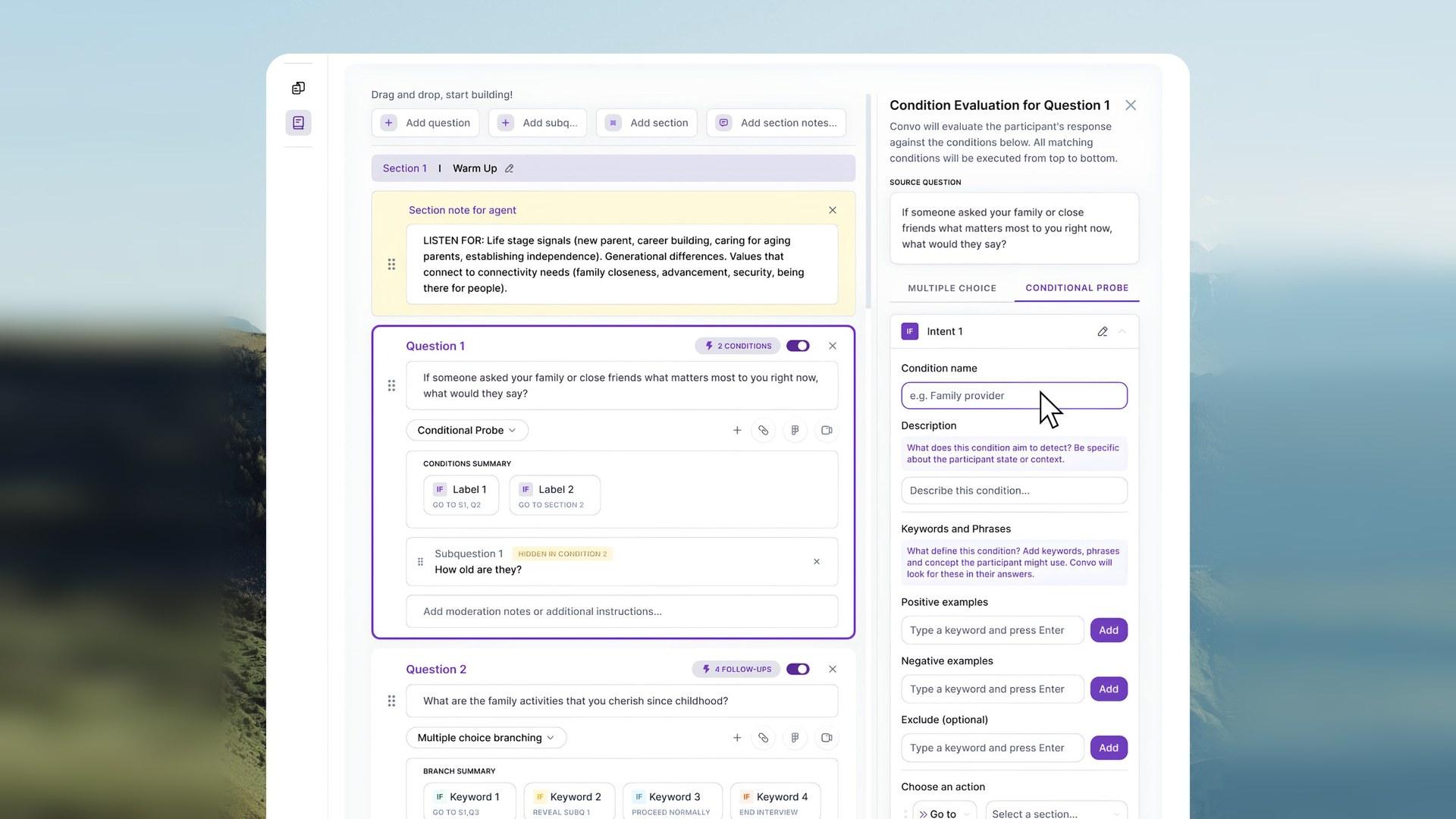
- Write your goal and the discussion guide. Introduce your brand, write your goal and add your questions. Researchers write and approve the guide and set branching rules: when a shopper mentions an abandoned cart, the AI interviewer asks what stopped them.
- Plan the sessions. One before the weekend, one each day from Black Friday to Cyber Monday, and one after the orders arrive. A Convo study can run for days or weeks.
- Add anything you want a reaction to. Your Black Friday ad, landing page or a mockup: Convo presents it to each participant as the conversation begins, as in a concept test.
- Test the interview before launch. Take it yourself and fix any question that confuses you before a shopper sees it.
- Invite shoppers. Invite your own customers or a customer list, or we recruit participants for you, ourselves or through recruiting partners who check people for fraud and bots.
- Let it run. Convo’s AI interviewer runs voice, video and chat interviews in 40+ languages and asks follow-up questions as people answer. Interviews run in parallel with no scheduling. Reward participants after each session to keep them taking part.
- Read the findings as they arrive. Convo turns every conversation into themes, sentiment, quotes and highlight reels, and every quote is the participant’s exact words. Its Research Assistant answers questions across the study with counts of people and their exact words, so every finding can be traced back to the conversation it came from. Researchers edit the themes before sharing.
If your team is busy running the sale, Convo’s research team can design, run and synthesise the study end to end.
Questions to ask at each moment
Ask about things people did, in their own words. Copy these into your discussion guide and adapt them to your products.
Before the weekend
- What are you planning to buy this Black Friday, and who is it for?
- Is there anything you’ve been waiting for Black Friday to buy? Since when?
- Walk me through how you’ll decide where to buy it.
- What makes a discount feel worth it to you? What makes one feel fake?
- How do you hear about deals: emails, apps, social media, price trackers?
Black Friday to Cyber Monday (one short entry a day)
- Show us the last thing you added to a cart today. What made you add it?
- Did you leave anything in a cart without buying? What stopped you?
- Which deal caught your eye today, and where did you see it?
- Did you compare prices before buying? Where, and what did you find?
- What, if anything, annoyed you about shopping today?
After the orders arrive
- Which purchase are you happiest with now that it’s here, and why?
- Is there anything you regret or plan to send back? What happened?
- How did delivery compare with what you expected?
- Did any shop earn your trust this weekend? What did it do?
- What will you do differently next year?
Follow-up rules worth setting
- A shopper mentions an abandoned cart: ask what would have made them finish the order.
- A shopper compared prices: ask which shop won, and why.
- A shopper bought a gift: ask how they chose it for that person.
What to do with what you learn
Give each team the part of the findings it can act on, while Christmas shopping is still ahead.
- Merchandising: what people waited for, and which offers felt real. It can change next year’s offers and stock.
- Marketing: where people found deals, and the words they used. It can change channels, timing and copy.
- E-commerce: where carts were left behind, and why. It can change checkout and delivery costs, before the Christmas orders peak.
- Customer service: delivery and returns problems. It can change delivery promises and the returns process.
Share highlight reels, so each team hears shoppers say it in their own words, and back each decision with themes, sentiment and real quotes. Keep the discussion guide: run it again next year and you can compare the two weekends.
A timeline for this year
Start by 20 November to reach shoppers before Black Friday.
- 19 to 20 November: write the discussion guide, test the interview and invite shoppers.
- 21 to 26 November: interview shoppers before the weekend.
- 27 to 30 November: daily diary entries, from Black Friday to Cyber Monday.
- 3 to 10 December: follow-up interviews, once orders have arrived.
- 11 December: share the findings.
Black Friday and Cyber Monday are fixed; the other dates are a suggestion. Leave a few days after Cyber Monday before the follow-up, so orders have time to arrive.
Frequently asked questions
Black Friday is Friday 27 November 2026, the day after US Thanksgiving. Cyber Monday is Monday 30 November 2026.
As many as you need: Convo runs every participant’s sessions in parallel with no scheduling, so reach isn’t the limit it is with moderated research. Interview enough people in each group you care about, such as new and returning customers, to hear the same reasons more than once.
Yes. Convo’s AI interviewer runs interviews in 40+ languages, and every theme stays traceable to the person who said it.
No. You can invite your own customers or a customer list, or we can recruit participants for you, ourselves or through recruiting partners who check people for fraud and bots.
Interviews run in parallel and analysis is automatic, so you can read themes the same day you launch. In a diary study, entries are analysed as they arrive, so themes build up over the weekend.
Convo operates from the EU and is designed to be GDPR-compliant, with data encrypted in transit and at rest.